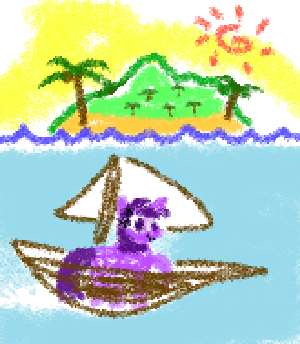
Of Knights & Kneighves
♞ 1.0The waters were calm and breeze balmy the morning Twilight Sparkle finally spied, dropped anchor at, and dinghied up to the island whose fascinating social customs had filled her fillyhood with countless evenings of logical recreation.
Here she finally was: The Isle of Knights and Kneighves she'd read so much about. "But I always thought it was just an old ponytale. Could the accounts really be true after all?" Sure enough, as she scaled a bank of sand, a disambiguating sign rose into view to welcome her, or anypony really, passing into town.
The sign, which was comprised of a banner hung between the two oldest palms, marked a population of a thousand and one. "Tough task ahead I face," she sang, trying to shake off her nerves, before as it happened actually
bumping into one such member of the populace, sending them both into a pratfall.
♞ 1.1Q
Twilight would later insert here, for the convenience of her readers (and perhaps to distract from her little faux pas), rules with which she had already been long familiar: that unlike Equestria, which contained ponies of infinite habits and attitudes, this small island-nation's inhabitants were all either knights, who always told the truth, or knaves, who always lied.
Now Twilight had had much time to think about what she would say in just such a scenario, and she had come up with a very curious question.
Twilight asked, "Will you reply as a knight would reply in answer to this question?" to which the native responded either "yes" or "no."
Could Twilight tell if the native was a knight or a knave? If so, which?
♞ 1.1A
A pony with the very apposite name of Saddle reasoned correctly that:
If the native is a knight, it would reply "yes," as a knight would. If the native was a kneighve, if it replied "yes," that would be as a knight would reply, so it would contradict kneighves always lying. If it replied "no," that would not be as a knight replied, again telling the truth leading to a contradiction. I guess the only possibility is the kneighve would have to remain silent?
From here, it is only a short trot to the solution. Since a kneighve would have had to remain silent, and since we are told that the native did not (instead "respond[ing] either 'yes' or 'no'"), our respondent must have been a knight.
Another, perhaps more penetrating, question to ask is, well, "Why did Twilight pose 1.1Q as her first inquiry anyway?" It wouldn't be fair to ask this of you, since it cannot be discovered by deduction. Lucky for you, I once had occasion to ask her quite directly myself, and I will never forget her answer:
Even the most well-intentioned Ponyvillians tell lies here and there. And while I know that the pony who lies circumspectly—e.g., to shield a foal's innocence or keep safe a good secret or one out of harm's way, and so on and so forth—is living with total moral rectitude, these same powers that save so many precious things still leave me in shreds of doubt. Every sweet word, from pleasant chat to love-declaration, could actually be, rather than the warmth I take it for, the clashing armaments of some enshrouded battle... Put simply, in a world that's a threat to us, where lies may be virtuous, what trust can survive? Only a very attenuated sort.
Naturally, I find the idea of a pony who only tells the truth very comforting, and I've always wished for a less imperfect world, one with ideal conditions for such a pony to emerge that would also be morally tenable. So I wanted the first islander I spoke to to be a knight, and I formulated 1.1Q to ensure this.
As I puzzled on through Abercrombie's tales, I couldn't help but speculate what factors could produce a caste so unwaveringly true. Were they immortals whose lives, therefore, could not be threatened? If so, were they then very brave and endurant or simply lacking nociception? Perhaps it was only that lying, as a knight, was considered immensely shameful and even illegal.
It very much disturbed Twilight to imagine a society in which lying was a way of life for one class but forbade to another. And Abercrombie's uninquisitiveness on this point had continually baffled her as she wormed through the apples of his volumes. Second only to her theory which exhorted knights as Pained and Brave Immortals, her favorite explanation went like so: In spite of the occasional crime (which Abercrombie had done well enough to document), The Isle of Knights and Knaves was altogether a veritable Utopia, without a real harm's way to get out of, and so lies here served only as a form of mild recreation—rather than on, for example, Earth, which every further thing she'd heard about made it seem that much worse and more deserving of her heroic antics than Equestria, and where they were always engaged in a mad clashing of spears against shields which had just now or were right about to split, spreading virulence and justification, ecological murder and human slaughter.
But despite that Pained-and-Brave-Immortals was not, she had to in the final analysis admit, the most likely of her several (here highly abbreviated) theories, she retained an affinity for the idea which shared something in common with belief—a certain self-steeling glow—but could not, in her world, be totally trusted. . .
♞ 1.2Q
Now big questions are well and good but all her seafaring had rendered Twilight Sparkle hungry, so she took her bow and cantered off ahead, searching for the way into town, which was still quite a ways off by the looks of it: the closest habitations seemed the size of sugarcubes on the horizon and enormous sugarcane fields stretched between each one, while just in front of her extended a blue and a green river. She now recalled having read once that one of these rivers would take her where she wanted to go, but she could not quite remember which.
Coming upon a pair of ponies, Twilight asked, "What color is the water of the river that leads into town, blue or green?" Pony A whispered inaudibly into pony B's ear, and the following exchange unfolded:
B: A told me, "The water is green."
A: That's true. I can say, "The water is green."
B: I can't say, "I am a knight."
A: I can't say, "I can't say, 'I am a knight.'"
So, what color was the river Twilight galloped along the bank of into town? Additionally, can you determine A and B's roles?
The story will continue if I receive the correct answer by comment or email at loneliwish@gmail.com.